Description
Description
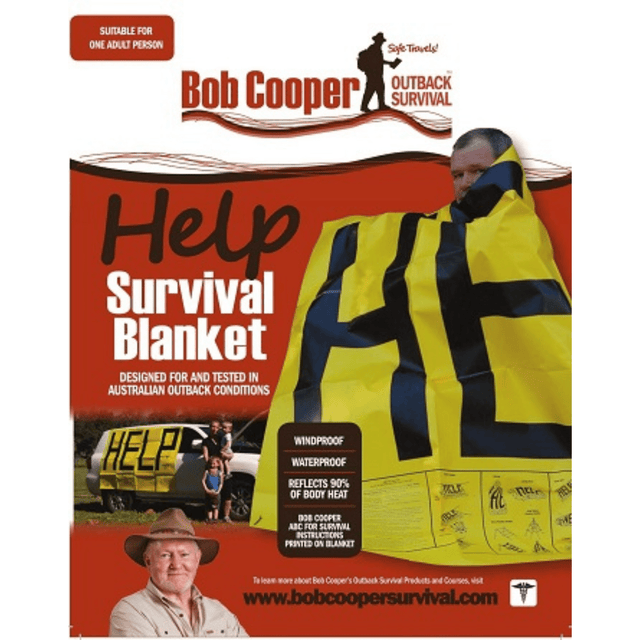
The Bob Cooper Help Survival Blanket is a 70 g emergency blanket, 2 m by 1.3 m, that does three jobs: a bright yellow distress signal printed with a giant HELP, a windproof and waterproof shelter, and a reflective silver side for warmth and treating shock. It was designed and tested in Australian outback conditions and folds small enough for a pocket.
What it covers
Bob Cooper has taught outback survival in Australia since 1990, and this safety blanket is built around his priorities for staying alive while you wait to be found: stay warm, get out of the weather and make yourself seen. Lay it out yellow side up in a clearing and the black HELP lettering tells a search aircraft exactly what it is looking at. Wrap up in it silver side in and it holds back body heat for someone who is cold, wet or in shock. Rig it over a cord or branch and it becomes a windproof, waterproof shelter from sun, rain or a cold night.
It belongs in every day pack and first aid kit, from a summer walk in the Flinders Ranges to a winter trip in the Victorian Alps, and in any kit for remote travel where help may be hours away.
What is inside
One blanket, with the instructions printed on it. Alongside the HELP signal, the yellow side carries 10 short, illustrated sections of survival information, covering how to pitch it as a shelter and how to lay it out to signal. You do not need to remember a course when the guidance is in your hands.
- Bright yellow face with large black HELP lettering
- Highly reflective silver reverse
- Windproof and waterproof
- 10 printed sections of survival information
Weight and packed size
The Help Survival Blanket opens to 2.0 m long by 1.3 m wide, enough to wrap an adult, and weighs 70 g. Folded, it is pocket-sized, so there is no reason to leave it at home.
Looking after it
Keep it folded in its pack until you need it, away from sharp gear that could puncture it. If you open it for practice, refold it loosely along the original folds and check it before each trip.
Specifications
Specifications
-
Dimensions
-
Type
-
Weight